Best Budget Audio Interface Under $200 (Six Real Options)
The best budget audio interface is the Audient EVO 4 at $137.50, which gives you two microphone preamps and a smart gain button that sets both levels from a real performance. Under $100 the PreSonus AudioBox 96 at $94.99 still gives two preamps plus hardware MIDI, and the Behringer UMC22 at $52.90 is the cheapest unit worth owning, limited mainly by its 16 bit converter.
Definition: A budget audio interface is a two channel converter and preamp box under about $200, which in a home room is limited by its preamp gain and headphone output rather than by the quality of its analog to digital conversion.
The best budget audio interface is the Audient EVO 4 at $137.50. Two preamps, Audient circuitry, and a smart gain button that listens to an actual performance on both channels and sets the levels itself, which removes the single most common cause of a ruined first take. If the ceiling is lower than that, the PreSonus AudioBox 96 at $94.99 still gives you two preamps and MIDI, and the Behringer UMC22 at $52.90 is the floor.
The useful thing about shopping in this band is what you are not giving up. Analog to digital conversion converged years ago. A converter at $137 and a converter at $999 will not sound different to you in a home room, and anyone who tells you otherwise is selling the expensive one. What you actually trade away below $200 is preamp gain at the top of the range, headphone amplifier power, metering and extra outputs.
What counts as a budget audio interface?
For this page, anything under about $200, which is a genuine dividing line rather than an arbitrary one. Below it you are buying a two channel box with exactly what you need to record. Above it you start paying for four analog outputs, front panel metering, hardware compression and routing, which are workflow features rather than quality features.
Two things move independently of price in this band. Bit depth is the first: a 24 bit converter gives roughly 144 dB of theoretical dynamic range against about 96 dB at 16 bit, and while 96 dB is more than any home room needs, the extra range is what forgives a gain mistake. Preamp count is the second, and it is not correlated with price the way you would expect: the $94.99 AudioBox has two preamps and the $208.07 M-Audio bundle has one.
Which budget interface should you buy?
Three tiers even inside a budget page, because these are still three different decisions. The beginner tier is the absolute floor and the specialist boxes. The intermediate tier is the pick most people should land on. The expert tier here is the top of the band, where a bundle starts making sense, and it is the tier most readers should skip.
Budget audio interface picks, under $200

Behringer U-Phoria UMC22
One preamp, phantom power, and a 48 kHz 16 bit ceiling for $52.90. It records a voice, and it is honest about being nothing more than that. The 16 bit converter is the real limit, because it gives you far less headroom to be wrong about gain.
Best for: Proving to yourself that you will keep recording before spending real money.
Check price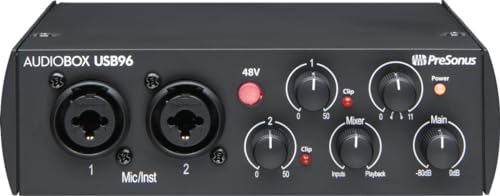
PreSonus AudioBox 96 (25th Anniversary)
Two preamps, MIDI in and out, 24 bit at 96 kHz, for $94.99. Nothing else near this price gives you two XLR inputs and hardware MIDI at once, and two preamps means a singing guitarist can track both parts in one pass.
Best for: A first interface for two sources at once on the tightest realistic budget.
Check price
IK Multimedia AXE I/O One
One preamp and one very good instrument input with a switchable pickup impedance control, which changes how a passive pickup loads and is a real tonal difference rather than a marketing feature. It also has a re-amp output.
Best for: A guitarist who records direct and re-amps, and rarely uses a microphone.
Check price
Audient EVO 4
Two Audient preamps, a metal-shelled converter path and a smart gain button that listens to a real performance on both channels and sets the levels for you. For $137.50 this is the point where a budget interface stops feeling like a compromise.
Best for: Almost everyone shopping under $200.
Check price
PreSonus Studio 24c
Two preamps, MIDI in and out, and a 192 kHz ceiling for $149.99. On paper it beats the EVO 4 on connectivity and sample rate. What it does not have is smart gain, which is worth more day to day than either of those.
Best for: Anyone who owns hardware MIDI gear and does not want a second USB box for it.
Check price
M-Audio AIR 192|4 Vocal Studio Pro bundle
A bundle rather than a bare interface: the AIR 192 4 plus a microphone, headphones and cables for $208.07. One preamp only. It is the cheapest path from nothing at all to a complete working chain in one order.
Best for: Someone starting from zero who owns no microphone and no headphones.
Check pricePrices change often, confirm on Amazon. As an Amazon Associate we earn from qualifying purchases.
How do the budget interfaces compare on paper?
Physical analog jacks only, and note where the preamp count breaks from the price order.
| Interface | Price | Mic pres | Max rate | Bit depth | MIDI | Connection |
|---|---|---|---|---|---|---|
| Behringer UMC22 | $52.90 | 1 | 48 kHz | 16 | No | USB-B |
| PreSonus AudioBox 96 | $94.99 | 2 | 96 kHz | 24 | Yes | USB-B |
| IK Multimedia AXE I/O One | $129.99 | 1 | 192 kHz | 24 | No | USB-C |
| Audient EVO 4 | $137.50 | 2 | 96 kHz | 24 | No | USB-C |
| PreSonus Studio 24c | $149.99 | 2 | 192 kHz | 24 | Yes | USB-C |
| M-Audio AIR 192|4 bundle | $208.07 | 1 | 192 kHz | 24 | No | USB-C |
The 192 kHz column is the one to ignore. Recording at 192 kHz quadruples your file sizes and quarters your available buffer time for no benefit anyone has demonstrated in a listening test. Track at 48 kHz. The sample rate comparison lays out the whole argument, and the sample rate and latency chart shows the cost in milliseconds.
Why does the EVO 4 win at this price?
Smart gain. Press the button, ask the performer to play or sing the loudest thing in the song, and the EVO 4 sets the level on both channels from what it hears. That sounds like a convenience feature. It is not. Setting gain from a spoken test rather than from the performance is the most common way a first take gets ruined, and this is the only box under $150 that removes the problem instead of documenting it in a manual.
Everything else is competent rather than remarkable: 24 bit at 96 kHz, two preamps, one headphone output, USB-C bus power, and a shell that is plastic rather than metal. The Studio 24c beats it on paper for $12.49 more with MIDI ports and 192 kHz capability. In practice the smart gain button is worth more than either.
I have set gain wrong on a first take more times than I want to write down, and it is never because I do not know how. It is because the singer sounds like one person in the room and a different, much louder person the moment the headphones go on and the track starts. The workflow that fixed it for me is boring and it works: ask for the loudest phrase in the song before touching a knob, set peaks around -10 dBFS from that phrase, then leave the preamp alone for the rest of the session. Verses will meter low. That is correct. Twenty four bits gives you about 144 dB of range, so quiet is free and clipped is gone.
What does a cheap interface actually cost you?
Four specific things, none of which is converter quality.
- Preamp gain at the top of the range. Budget boxes commonly stop at 50 to 56 dB. A low-output dynamic microphone at speaking distance wants 60 to 65 dB. Run your microphone through the gain staging calculator before you order.
- Headphone output power. A 250 ohm pair of open backs will not reach a usable level from most budget headphone amps. If you own high impedance headphones, this matters more than any other line on the spec sheet.
- Outputs. Two analog outputs means the monitors are the only thing you can send to. Four outputs is what lets you run an outboard hardware loop or a second headphone mix.
- Metering. A ring of LEDs around a knob tells you far less than a real meter. This is a workflow cost, not a sound cost, and it is the one that annoys you daily.
Is the 16 bit converter in the UMC22 a real problem?
It is a real limit and it is not the limit people assume. Sixteen bits gives about 96 dB of dynamic range, which comfortably exceeds the noise floor of any home room, so nothing about a well-recorded track at 16 bit sounds worse. The problem is margin. At 24 bit you can track a nervous performer with peaks at -20 dBFS, normalise later, and lose nothing. At 16 bit that same take is using only the top 76 dB of the range, and when you bring it up you bring the converter noise up with it.
Put differently: 24 bit makes headroom free, and headroom is what beginners need most. That is the argument for spending $42 more on the AudioBox 96 , and it is a better argument than anything about sound quality. The dB reference levels chart puts the numbers in context, and how to set recording levels covers the -18 dBFS RMS target the whole site uses.
Who should not buy the expert tier?
Do not buy the M-Audio AIR 192 4 bundle at $208.07 if you already own a microphone and headphones. You would be paying $208 for a single-preamp interface plus a second microphone you will not use, when the EVO 4 gives you two preamps for $137.50 and leaves $70 for a bass trap. The bundle is excellent value in exactly one situation: you own nothing at all and want a complete working chain to arrive in one box.
The same reasoning applies to the AXE I/O One at $129.99. Its impedance switching and re-amp output are genuinely useful and genuinely specialist. If you record a voice more often than you record a guitar, one preamp is a real ceiling and you have bought a guitar interface by accident.
Where should the money you saved go?
Into the room, and it is not close. The gap between the UMC22 and a $999 interface is enough for four corner bass traps, four first reflection panels and a good microphone. Every one of those changes what comes out of your speakers more than any converter upgrade will, because the room is printed permanently into every file you record and can never be removed afterwards.
Start by putting your dimensions into the room mode calculator to see where your problem frequencies land, then size the coverage with the acoustic treatment calculator. The panels roundup covers what to actually buy. If you would rather see the whole chain costed at once, the beginner build puts an interface, a microphone, a stand, headphones and first treatment together with a running total.
What to buy alongside it
The interface is one link. You also need a microphone, an XLR cable, a stand and headphones before anything can be recorded at all. For a treated or reasonably quiet room, start with the vocal microphone roundup. For a bare room with parallel walls, a dynamic will serve you far better, and the dynamic microphone roundup explains why. Add closed back tracking headphones so a click does not bleed into an open microphone, and a stand or boom arm that keeps footfall out of the capsule.
When you outgrow this band, the full interface roundup covers the $200 to $1,000 range, and the interface database has published specifications for every unit named on either page.
Full reviews of the interfaces here
The MOTU M2 review covers the metering and MIDI combination and the build quality tradeoff that pays for it, and the Scarlett 2i2 review covers the safest first purchase and why a more expensive interface will not sound better.
Frequently asked questions
What is the best budget audio interface?
The Audient EVO 4 at $137.50. Two preamps, a smart gain button that sets levels from an actual performance on both channels at once, and Audient preamp circuitry in a box that costs less than a decent microphone. The cheaper PreSonus AudioBox 96 at $94.99 is the pick if you also need hardware MIDI, and the Behringer UMC22 at $52.90 is the floor.
How cheap can an audio interface be before it stops being usable?
Around $50, and the thing that breaks first is bit depth rather than sound. The Behringer UMC22 records 16 bit at 48 kHz, which gives about 96 dB of dynamic range instead of the 144 dB a 24 bit converter offers. That is still plenty of range, but it leaves far less room to be wrong about gain, and being wrong about gain is what beginners do.
Is a budget interface good enough for professional-sounding recordings?
Yes, and the room is what stops you, not the converter. Converter performance converged so completely at the budget end that a $137 interface and a $999 interface will not differ audibly in an untreated bedroom. What a cheap interface genuinely limits is preamp gain, headphone output power and driver behaviour at small buffers. None of those is the sound of the recording.
Do budget audio interfaces have enough gain for an SM7B?
Usually not comfortably. A low-output dynamic at speaking distance needs 60 to 65 dB of clean gain, and interfaces in this price band commonly publish 50 to 56 dB. You will reach a level by pushing the preamp into its noisiest region and hearing hiss under quiet passages. The fix is an inline booster of about 25 dB at the microphone, not a more expensive interface.
Should I buy an interface bundle with a microphone included?
Only if you own no microphone and no headphones. The M-Audio AIR 192 4 Vocal Studio Pro bundle at $208.07 is genuinely cheaper than buying the parts separately, and the parts are adequate rather than good. If you already own a microphone you like, a bundle means paying for a second one you will not use and getting one preamp instead of two.
What do you give up by buying a budget interface instead of a $300 one?
Preamp gain at the top of the range, headphone amplifier power, front panel metering, and in most cases the extra pair of analog outputs that lets you run an outboard loop. You also give up a metal chassis on some units. What you do not give up is converter quality in any way you will hear in a home room, which is the part people assume they are buying.
Working out your own room and signal chain? The Home Studio Build Planner is the paid version of these pages: 8 printable worksheets you fill in with your own numbers, plus the full PDF, $29.